
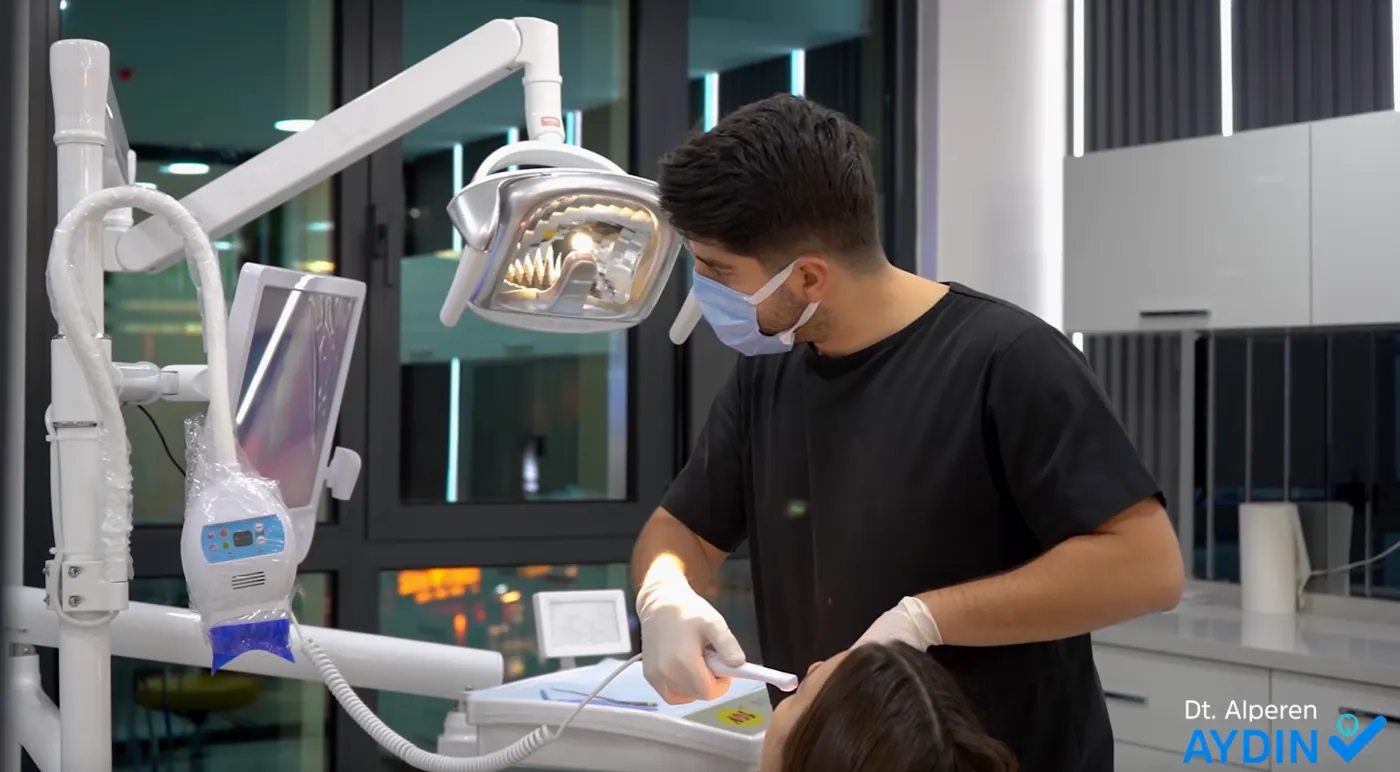
When decay or a fracture reaches the pulp, where the tooth’s nerves and blood vessels are, it can cause severe pain, sensitivity to hot and cold, and swelling. Root canal treatment aims to keep the tooth by cleaning out the infected tissue and filling the canals.
Drawing on his training in endodontics, Dt. Alperen Aydın performs root canal treatment at the practice under local anesthesia.
Signs you may need a root canal
- Pain that starts on its own or gets worse at night
- Lingering sensitivity to hot and cold
- Darkening of the tooth
- Swelling or a pimple-like discharge on the gum
After root canal treatment
The tooth may feel tender when chewing for a few days. To prevent teeth with significant structure loss from fracturing, a crown or onlay may be recommended instead of a filling.
Treatment steps
- 1
Diagnosis
X-rays and tests identify the problem tooth.
- 2
Anesthesia
Local anesthesia is given.
- 3
Cleaning and shaping
The canals are cleaned and disinfected.
- 4
Filling and restoration
The canals are filled and the tooth is completed with a filling or crown.
Frequently asked questions
Does a root canal hurt?
The procedure is carried out under local anesthesia, and most patients find the treatment itself comfortable. There may be brief tenderness afterwards.
How many visits does a root canal take?
Depending on the tooth, it is completed in one or several visits. If there is significant infection, an extra visit may be needed.
Isn’t it better just to pull the tooth?
We recommend keeping your natural tooth whenever possible. An extracted tooth needs to be replaced with an implant or bridge; a tooth that can be saved with root canal treatment is often the more conservative option.
This page is for general information. The right treatment and its duration are decided by your dentist after an examination.